

The New Managers Guide to Understanding The Role
A series where I walk you through the training you never got as a new Engineering Leader. In part 1 of a 5 part series, I discuss the lack of training and what that looks like with 10 tips.
This is the first part in a five part series where I create a guide for new engineering managers. Each part will touch on a key topic, when brought together will aim to give you a head start on the training you never got.
The ‘New Managers guide to Leadership Success’ is broken down into the following parts:
Part 3: Decision-Making
Part 4: Leadership Behaviours
Part 5: Adding it All Up
What’s The Job Spec?
Someone once said to me that the true Engineering Managers job description is to enable really smart people to make them look good.
The truth is that there is more to it than that. The inclusion of the word enable is good and I like that they are highlighting smart people.
If I had to rewrite it in the same vain I would go for:
To enable really smart people to achieve business outcomes and deliver business value.
The first thing with importance is that you are there to deliver business value. The term business value should always be front of mind when crafting roadmaps and delivering. I will refer to this phrase constantly through this 5 part guide.
The second part is that you cannot do that without a happy team. And you cannot have a happy team without treating them like adults and enabling working to outcomes.
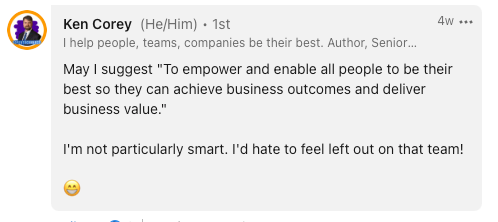
Ken Corey, the co-author of ‘Bad Bosses Ruin Lives’ takes my definition a step further with empathy.
Becoming an Engineering Manager
People become an Engineering Manager in one of two ways; either they are moved into the role at their current employer or they are given the chance by a new one.
If they are moving into an Engineering Manager role at a new company, it’s because they have sought it out. That’s not always true when moved to it from being a software engineer in the same organisation. I first became an Engineering Manager at the start of covid, when we weren’t hiring and the company really needed the role filled. I had no idea what it entailed or if I was going to be up for the job. I went in blind, and that is a familiar story.
The thing both of those avenues into engineering leadership have in common are that you are going into a new role. It’s a role that requires a set of skills that you won’t have had much exposure to as a software engineer.
Software Engineering Managers are Rarely Trained
This isn’t groundbreaking information. Yet new software engineering managers are rarely trained for their new role. All of a sudden you are responsible for the output and welfare of a group of individuals and there is rarely any training that’s not on the job learning.
Working in technology, we need to be comfortable with failure, and that truly is a path to success. That feels different when your failure could have a direct impact on the lives of those people you are leading.
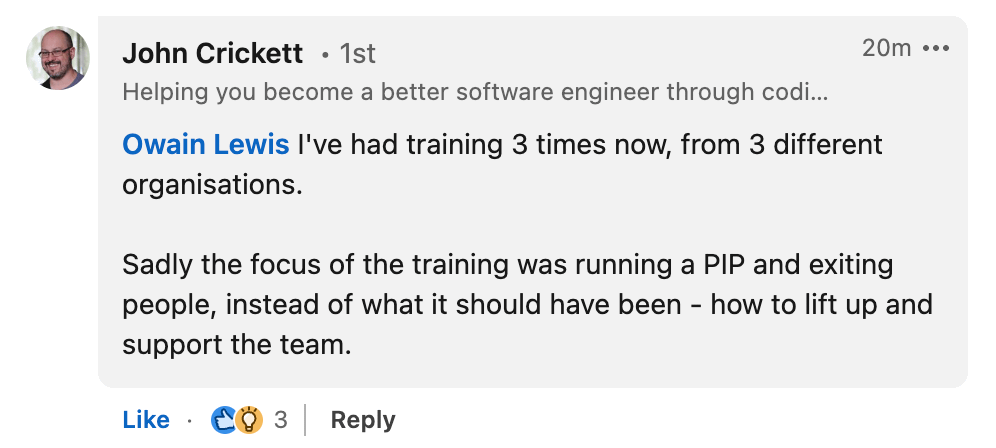
Unfortunately, much of the training you do encounter is around practices such as the PIP (performance improvement plan) and exiting people as John Crickett of Coding Challenges pointed out.
Only Trained to be a Manager
Performance management, like the things you are trained on, as John points out above, is important. I agree with him, it’s sad. The team will notice if you are not making hard decisions which will benefit the team overall. I will touch on this more in part 3, but sometimes you need to make the hardest of decisions. For example, If you have an under performer in the team, and you have tried to coach them and they are not performing at the level required then the best thing for the team is often to part ways. In my experience, the engineers will have been dealing with the hurdle of carrying this person for a while.
Things like performance management are important topics to become familiar with that fulfil the ‘manager’ part of the job. To be a leader however, there is more to it and that we can train new managers on. We must see a shift to giving new managers the space, time and investment to become leaders. Just training them for HR situations is not good enough.
Becoming a Leader
Sarah Allen, a Lead Product Manager at Yelp once told me: A leader can sometimes be a manager, but being a manager doesn’t always mean being a leader.
This is where ‘The New Managers Guide to Leadership Success’ comes in. Over the course of 5 parts I aim to help you understand what it takes to go beyond being a manager and understand hard learnt lessons from 15 years in the industry.
Being an Engineering Manager is hard. You need to manage diverse teams with kindness, balance stakeholder expectations, facilitate career development, ensure effective communication and much more. Good leaders are emotionally connected to the welfare of their team, and that can be draining.
Being a manager when when times are good is easy. Being a leader when times are tough is hard.
Being a manager is essential but it’s not good enough. You need to go beyond your managerial responsibilities and look to guide your team into delivering business value in a healthy and sustainable way.
Here are 10 lessons I have learnt over a 15 year career which can help you do that:
Stop being a senior engineer.
Learn to say no.
Communicate often and early.
Ally with product.
Keep the teams focus.
Your role is to guide, not decide.
Default to transparency, always.
Coach them, don’t tell them.
Give feedback early.
Sometimes you do need to be the manager.
Over the next 4 parts of ‘The New Managers Guide to Leadership Success’ I will dive into all 10 of these in more detail and hopefully give you the blueprint to learn lessons I had to learn the hard way.
Of course, this list is not exhaustive, it’s a great start.
What else would add to the list?
Stay tuned and subscribe for part 2.
Hey folks, this is Ryan with another edition of The Software Engineering Times. I look to enable the future and current generation of technology leadership. You can subscribe for free and get weekly issues straight to your inbox. Paid subscribers get the full archive of issues, access to free resources, templates, special offers, 10% off coaching, and access to a private community.
This newsletter recently hit 4,200 subscribers, that’s so wild. Just quickly whilst I have you:
Check me out on LinkedIn. Im at >51,000 followers now.
Have a discount or deal that my paid subscribers would be interested in? Let me know and ill add it to the paid subscribers only area.
Interested in some form of sponsorship for this newsletter? Hit me up.
Just like every good YouTube opening, please like this (click the heart button at the bottom) and subscribe. It really keeps me motivated and gives me heaps of help.
Excited for the other parts!
Great start to the series. Looking forward to the next issue.