

The New Managers Guide to Communication and Collaboration
Part 2 of my guide for new or aspiring Engineering Managers. I focus on communication and collaboration and how this can change your game.
This is the second part in a five part series where I create a guide for new engineering managers. To read the first part go here.
When I first became an engineering manager, it was a couple of months into the COVID pandemic. Once working full-time in an office, we were now working full-time remotely.
There was worry, uncertainty and confusion amongst everyone. I was forced to learn communication the hard way, early in my management career. I made mistakes, and as always with management the people affected was the engineers and people I was meant to be leading.
A Critical Role
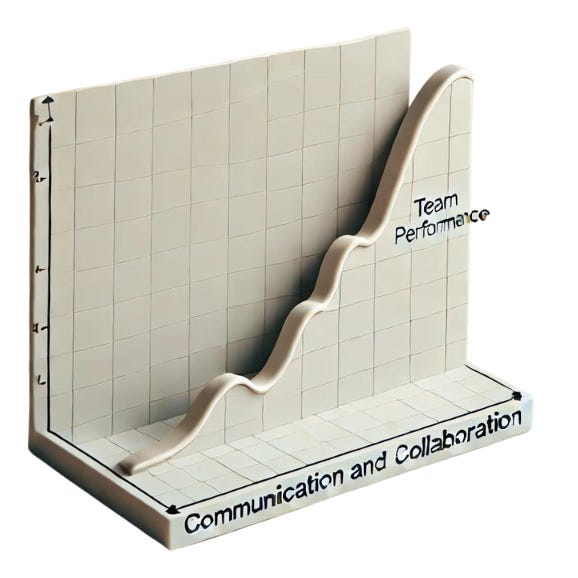
You cannot have a high-performing team without deep-rooted communication and wilful collaboration.
It’s the superpower of potential team disruption. It gets everyone on the same page, reduces misunderstandings, aligns the team and gets stakeholders bought in.
The impact is not limited to team cohesion and the individuals. It has a correlation on projects. Communication and collaboration help manage expectations, increase efficiency (therefore delivery) and reduces unwanted surprises (this is impossible to truly eradicate).
It’s Not Just Telling People Stuff
Communication is not just telling someone something. What matters is the message that was received more than the words delivered.
You need to check for understanding so that what you thought communicated is actually received by the listener.
It’s a two way thing. Your job as the manager is not just to do the talking and assume people know what you are saying.
Thanks to Sarah Allen, Lead Product Manager at Yelp and a great friend for this reminder throughout the last couple of years.
Communication Often and Early
There are two golden rules to great communication as an engineering manager with stakeholders and your team; it needs to be proactive and it needs to be easy.
Stakeholders and your team should never feel like they wonder what the latest update is.
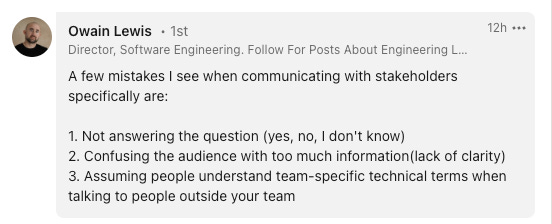
Communication does differ between audiences, you might give your team way more context and background than you might a stakeholder update. Owain Lewis, Director of Software Engineering at Oracle, highlights some common mistakes engineering manager make:
Three ways you can ensure you can stay on top of your communication and updates to stakeholders and the team are:
Establish regular check-ins - This can be team meetings, stakeholder emails, project gatherings or one-to-ones. The cadence needs to be predictable and the goal needs to be clear. Let people know what they are going to get out of this and give them a regular method for getting it.
Use multiple channels - Not everyone is receptive to information in the same way and also not every type of message should be shared the same way. Email, Slack (or Teams etc), wiki pages, documentation, Jira (or other project tools) are all tools at your disposal for you to ensure the communication channel matches the message type. For example, for quick informal updates, chat apps such as Slack are appropriate.
Give feedback and share information early - You need to be proactive when sharing feedback and updates. Feedback before it is asked for; this is a great rule to stick by. This doesn’t just mean constructive, if you are only viewing feedback as constructive, team morale is going to drive into the floor. With project updates, communication project status and any milestone changes should keep everyone on the same page. Read my post on transforming stakeholder updates for ways to improve your updates such as the traffic light method.
Default to Transparency, Always
As a new manager, when I first heard that I needed to default to transparency, in my head I always had challenging situations in my mind. I always thought this meant we needed to be constantly updating the team on problems and challenges they might face or are facing.
It’s more. It can be as simple as providing a safe space for people to give you information, or a regular cadence where you share information, even if there is no new information.
There are times when it is delivering more challenging news such as team member departures, company updates and constructive feedback. People deserve to know, and being early let’s them know them as humans were a priority to you. You valued them over your desire to have an easier life for the short term (delaying will bite you in the long term, I promise).
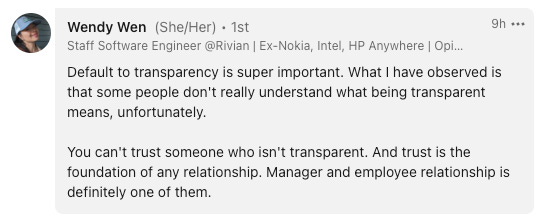
Wendy Wen a staff software engineer at Rivian, points out that transparency is the building block of trust. People leave managers, not companies, you need to be someone they can trust.
Here are 5 ways you can add some transparency to your communication:
Share information proactively - provide regular updates on projects, companies, performance. Good or constructive, share it in a regular forum.
Provide context - if scope changes, or goals, or there are company changes ensure you are sharing the relevant background information. If you don’t have it, go find it, and if you can’t, tell the team that and go work on it. Just be honest.
Address misunderstandings - If someone isn’t quite understanding, or there is misinformation, get to it before it escalates. Have open forums where it’s a safe space so people know there is at least that opportunity to share. Of course, they should always know it’s safe to ask questions at any time.
Encourage a feedback culture - Positive and constructive feedback is important to team and individual morale and future performance. Train your team on how to give feedback. Make it a routine part of your teams and your management practice.
Keep open channels - The first rule of software engineering club is that there is no such thing as a dumb question. Ensure information and decisions are open to everyone to find easily, don’t lock them away. Ensure people have a safe space to raise questions and concerns, even if that isn’t to you. Engineers need to know they can talk to other managers if they don’t feel comfortable talking to you about a subject.
Ally with Product
One of the most important collaborations you will need to make is with product, by this I mean your product manager, product owner, a product counterpart of some sort. Not everyone has this person in their organisation with this dedicated role. If that is you, make it a priority to work out who is responsible for the product decisions.
When I was a mid-weight engineer I had a boss who was always at war with product. They never agreed with the decisions, they always seemed to have a vendetta against whoever was in that product role. Looking back, it was a power struggle this person couldn’t recognise. It negatively affected our team, decisions were slow, tension was high in planning, and honestly… we all just always left meetings feeling a little salty.
Don’t be my old boss. Your job is to enable your team to deliver business value and achieve business outcomes. This goal is made a lot easier if you have a strong product ally helping guide you and the team as a cohesive unit and help understand business context behind a need to pivot or why we are doing a particular piece of work.
I view product as the guiding light of software engineering. They act as the lighthouse, where we might otherwise be sailing in the dark with only our headlamps.
Final Thoughts
Maintaining clear, contextual and transparent communication coupled with wilful collaboration can seem so obvious. So many new engineering managers struggle with implementing the frameworks to make this a lasting effect of their management practice, instead of something they do for a week because they got inspired from an article.
Implementing transparent and frequent communication does require effort. It’s a constant process that evolves with each team and individual you manage. What worked for one team, will not work for every team you manage.
The long term benefits are a cohesive team. It’s a motivated team. It’s a team that trusts you. This brings with it all the benefits you need to ensure you enable your team to deliver business value as a group of individuals that are treated like adults.
Hey folks, this is Ryan with another edition of The Software Engineering Times. I look to enable the future and current generation of technology leadership. You can subscribe for free and get weekly issues straight to your inbox. Paid subscribers get the full archive of issues, access to free resources, templates, special offers, 10% off coaching, and access to a private community.
This newsletter recently hit 4,300 subscribers, that’s so wild. Just quickly whilst I have you:
Check me out on LinkedIn. Im at >51,000 followers now.
Have a discount or deal that my paid subscribers would be interested in? Let me know and ill add it to the paid subscribers only area.
Interested in some form of sponsorship for this newsletter? Hit me up.
Just like every good YouTube opening, please like this (click the heart button at the bottom) and subscribe. It really keeps me motivated and gives me heaps of help.
The “ally with product” one is so crucial. I’ve been a part of that war too often..
And don't forget to use the language of the audience - speak in their terms so they understand the message.