

Why Do Some Software Engineers Leapfrog Up The Career Ladder?
Some people keep jumping up the career ladder. It's because of three things: luck, ownership and doing your job.
Hey folks, this is Ryan with another edition of The Software Engineering Times. I write for the software leaders of today and tomorrow. You can subscribe for free and get weekly issues straight to your inbox. Paid subscribers get full access to all past articles, personally curated resources, templates, special offers, 10% off mentoring, and access to a private community.
In my experience, there are three types of people when it comes to career progression:
Those who seem to keep jumping ahead.
Those who seem to take a bit longer.
The ‘somewhere betweens’. Those who jump quickly for a period and then take a bit longer in a repeatable pattern.
I’ve been around and managed all three types over my 15 years in technology. I’m number 3, a ‘somewhere between’.
Now and then, you will encounter the number one’s, the leap froggers. Every year or two, they will move up the career ladder, and before you know it, they have gone from a mid-weight engineer to a staff engineer, and the imposter syndrome starts to feel real.

In my experience, it comes down to three things: luck, ownership and doing your job.
Some People Seem To Be Damn Lucky
They are, and they aren’t.
From the outside, it can seem that a lot of people are in the right place at the right time. They join a company that is growing, and opportunities seem to fall in their lap.
I understand this point of view it happened to me, but it doesn’t tell the full story.
The chances are that if you join a fast-growing start-up, the chances of promotion are going to be much higher than if you join a larger company with more competition and more well-established level boundaries.
The two playing fields are not the same.
The truth is, though, that you have to be willing to be in that game to win it, and a lot of people like the brand recognition that comes with being at a larger company such as MAANG.
Even if someone is in that environment where opportunities are fruitful, and they keep landing in their lap, there are not many successful founders who will just give those positions away. They will still be earning them; they haven’t sat there, done nothing, and been given a promotion in an environment such as a start-up where these decisions are crucial to its growth and success. These people will still be seen as doing the other two things on my list, which make them trusted and good candidates for that role: they take ownership, and they do their job.
You will also find people in those environments who don’t get the opportunities.
All of this is true no matter what environment you are in; you need to take ownership, and you need to be doing your job well.
You Need To Do Your Job Well
As a manager, one of the key traps I see people falling into when chasing a promotion is trying to demonstrate they can do the desired job and letting their current job expectations falter.
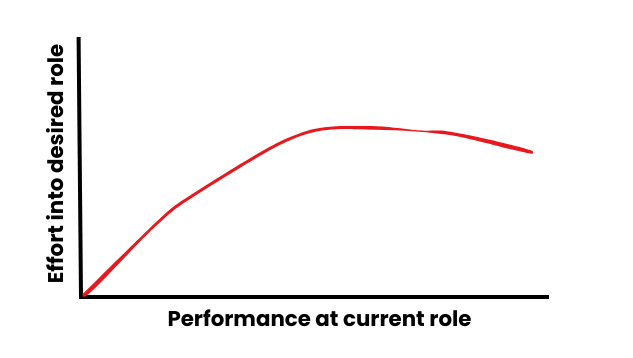
This isn’t a true rule that applies to everyone; it is a common problem I see people making. The more time and effort they spend putting into showing they can do the next role, the more they let go of what makes them a top performer in their current role.
This is a problem, more seriously, it can turn into a performance problem for you now while you chase your future.
When I go to promote you, I need to be able to demonstrate that firstly, you are great in your current role and that you nail the aspects of that, and I need to be able to give demonstrable evidence that you will be able to perform at that next role.
It’s a fine balance, and you need to do both.
I don’t want this to read that luck and circumstance doesn’t play a part, because they absolutely do!
You Gotta Take True Ownership
Ownership is more than just writing code. It means being accountable for the outcome of a project, a product, or whatever you said you would do.
Many of us focus on honing our technical skills but often overlook the importance of true ownership in our projects. Ownership requires moving beyond just technical competency and considering the entire life cycle and business value delivered by our work.
There are several things you need to consider, below I have listed 5 of them and discussed what it means, given an example and told you why it matters:
1. End-to-End Impact
What it means: You aren’t just concerned with your specific piece. You understand how your work fits into the broader system and how it impacts other areas of the project. ‘That’ll do, they can work it out’ isn’t good enough here.
Example: If you’re building a microservice, for instance, you’re not only thinking about your service’s performance but also about how it interacts with other services in production, its impact on latency, and how it integrates into the overall system architecture. Are you thinking of how this effects marketing, sales and customer service teams?
Why it matters: People who think this way are seen as valuable because they are proactive thinkers. They reduce bottlenecks and anticipate future challenges.
2. User Benefits
What it means: Being deeply aware of the end-user’s experience. It’s not just about writing clean code. It’s about understanding how your code will affect the user and making decisions that improve their experience.
Example: If you’re working on a UI feature, it’s not enough to make sure it functions correctly. You also need to think about how intuitive it is for the user, whether it solves their problem efficiently, and whether there are edge cases that could lead to degradation.
Why it matters: Engineers who focus on user outcomes build more impactful products. There are no two ways about it. This ability to align technical solutions with user needs is an asset that will see you through your career. Build this habit early
3. Business Alignment
What it means: Aligning your work with the company’s business objectives. This requires understanding the context behind what you’re building. How does it contribute to the company's success? What’s the larger goal?
Example: If you are working on optimising a feature for performance. Beyond improving speed, you also consider how this optimisation could reduce infrastructure costs, which aligns with the company’s goal of improving profitability. How might customer service be able to utilise this? Is this something sales could benefit from when selling?
Why it matters: Engineers who think about the business impact of their work are seen as strategic thinkers. They deliver business value which ultimately is what we are their to do.
4. Stakeholder Communication
What it means: It’s all about communication. Owning a project means proactively keeping all stakeholders (managers, designers, product owners, etc.) informed about progress, potential risks, and changes. Be honest. No one wins from saying something is rosy if it’s not.
Example: If a critical feature’s timeline is at risk, instead of waiting until the deadline to inform the team, you communicate early, offering potential solutions or alternatives to mitigate the impact.
Why it matters: Proactive communication builds trust. It shows that you’re thinking about the project from multiple angles, which builds trust.
5. Measuring Progress Beyond Your Part
What it means: Don’t just track the completion of your tasks. Care about the success of the entire project. You’re aware of how other parts of the project are progressing and whether they might impact your work.
Example: If you’re building a feature that relies on a backend API from another team, taking ownership means regularly checking in on the status of that API, identifying any blockers, and helping to solve them. Even if it’s outside your core responsibility. ‘That’s not my job’ isn’t good enough here.
Why it matters: Engineers who adopt this mindset are often seen as natural leaders. They think all around them. Having a cross-functional awareness is a key trait of more senior engineers and leaders.
Closing Thoughts
It might seem like some people leapfrog their way up the career ladder with ease and at a sharp pace. Just looking from the outside is not always the full story.
Sure some might just be truly lucky, but this run of luck is extremely rare and always catches up.
More often is the case is that they can demonstrate absolute capability at their current role with taking true ownership.
When I go to promote you, I need my peers to say: ‘Ah yeah, no brainer, let’s do it.’
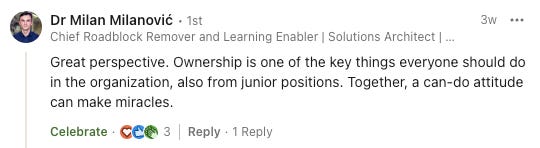
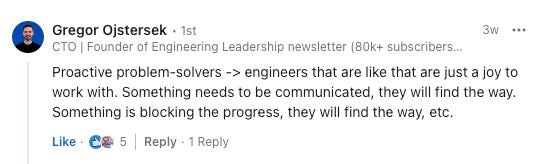
When I asked my LinkedIn audience about this topic I got some valuable insights:
This newsletter recently hit 5,300 subscribers, that’s so wild. Please like this (click the heart button) and subscribe. It keeps me motivated and gives me heaps of help.
Just quickly whilst I have you:
Want to write a guest post for this newsletter? Let me know!
Check me out on LinkedIn. I’m at >54,000 followers now.
Check me out on Threads. I’m at a whopping 30 followers.
Check me out on X (Twitter). I’m at a monstrous 50 followers.
Nice read Ryan! I also share the same thoughts as you, especially around how people should be promoted based on them demonstrating the skills required.
One thing I'd add to this is that although ownership is a key part of the process for 'leapfrogging', it also comes down to the environment in which they are in. If you're the only person taking any real degree of ownership, it's unlikely that it will get noticed and used as a lever for promotion - you just get seen as the person who get's stuff done (i.e. it's not seen as an appreciated trait). I think the academic term for this is 'social loafing'.
I've been on both sides of the fence. In companies where ownership is done by lots of people, great things happen and everybody appreciates the effort that others put in, rather than being pulled along for the ride.
Awesome write up on how to advance in your career and the value you are providing 🚀
Big Picture Ownership: beyond just clean code and tickets is massive and will help you standout.
Doing your job well: crush your current level and start working on the level above. Maintain that beyond just a few weeks or a month, and you are well on your way.
Luck: Totally agree. Sometimes it’s just being in the right place at the right time, doing the other two steps well and the stars will align. I’m a firm believer you can also create your own luck by consistently putting out good work, stretching yourself, helping others level up, and looking for those challenging growth opportunities.
Again, great write up Ryan! 👏🏼